The ‘Weird’ Animal Fat Balm That’s Replacing 5 Skincare Products in 2026
Beef tallow skincare is the ancestral beauty comeback of 2026 – grass-fed, bio-identical, and replacing entire 10-step routines with one $22 jar. Here’s why.
What Is Beef Tallow Skincare, Exactly?
- What Is Beef Tallow Skincare, Exactly?
- Why Tallow Is Bio-Identical to Human Skin
- The Grass-Fed Difference
- What Products Does Tallow Actually Replace?
- Who Is Tallow Skincare For?
- The Smell Question
- How to Start: The Simplest Tallow Skincare Routine
- Frequently Asked Questions
- The Bottom Line on Beef Tallow Skincare
If you’ve been anywhere near the natural beauty corners of TikTok or Reddit in 2026, you’ve probably seen it: someone tossing out their whole skincare shelf and replacing everything with a small jar of something that looks like whipped butter. Beef tallow skincare is not new — it’s arguably the oldest moisturizer on earth — but it’s having its loudest moment yet, and there are very specific reasons why.
This article breaks down what tallow skincare actually is, why it works, and how one brand — Purely Tallow — has turned a single grass-fed ingredient into a full routine replacement. If you want the deep-dive on how to layer it into your routine, jump to how to use tallow balm. If you want a first-person account from someone who swapped their whole routine, the full Purely Tallow review covers that.
What Is Beef Tallow Skincare, Exactly?
Tallow is rendered animal fat — in the context of skincare, almost always from grass-fed beef suet (the fat surrounding the kidneys). It has been used on skin for centuries across Europe, Asia, and indigenous cultures worldwide. Your great-grandmother probably had a version of it.
The modern skincare industry spent most of the 20th century replacing fats like tallow with plant-based oils and synthetic emollients. The reasoning was partly cultural (animal products = old-fashioned) and partly commercial (plant oils were cheaper to source and easier to standardize). The result: shelves full of products built around ingredients like dimethicone, cyclopentasiloxane, and PEG-derivatives — ingredients that often sit on top of skin rather than working with it.
Tallow’s return is a direct reaction to that. And the science supporting it is surprisingly solid.
Why Tallow Is Bio-Identical to Human Skin
The core argument for beef tallow skincare comes down to one concept: bio-identical fatty acid ratios.
Human sebum — the oil your skin naturally produces — is made up primarily of:
– Oleic acid (~25–30%)
– Palmitic acid (~20–25%)
– Stearic acid (~10–15%)
– Linoleic acid (~8–15%)
Grass-fed beef tallow has a fatty acid profile that mirrors this almost exactly. Oleic acid, palmitic acid, and stearic acid are all present in proportions close to what your skin already makes. This is fundamentally different from most plant oils, which tend to be very high in linoleic acid and low in the saturated fats that make up healthy skin barrier function.
What this means practically: tallow absorbs quickly and deeply, doesn’t just sit on the surface, and supports the skin barrier rather than potentially disrupting it. Brands like Purely Tallow describe this as “bio-identical” skincare — an ingredient so structurally similar to what your skin produces that the barrier recognizes and uses it.
The Grass-Fed Difference
Not all tallow is equal. The quality of the source animal — what it ate and how it lived — directly affects the fatty acid composition and nutrient density of the rendered fat.
Grass-fed cattle produce tallow with:
– Higher CLA (conjugated linoleic acid) content, a fatty acid with documented anti-inflammatory properties
– More fat-soluble vitamins — A, D, E, and K — all of which play roles in skin cell turnover and barrier repair
– A cleaner smell and whiter color due to lower beta-carotene conversion compared to grain-fed
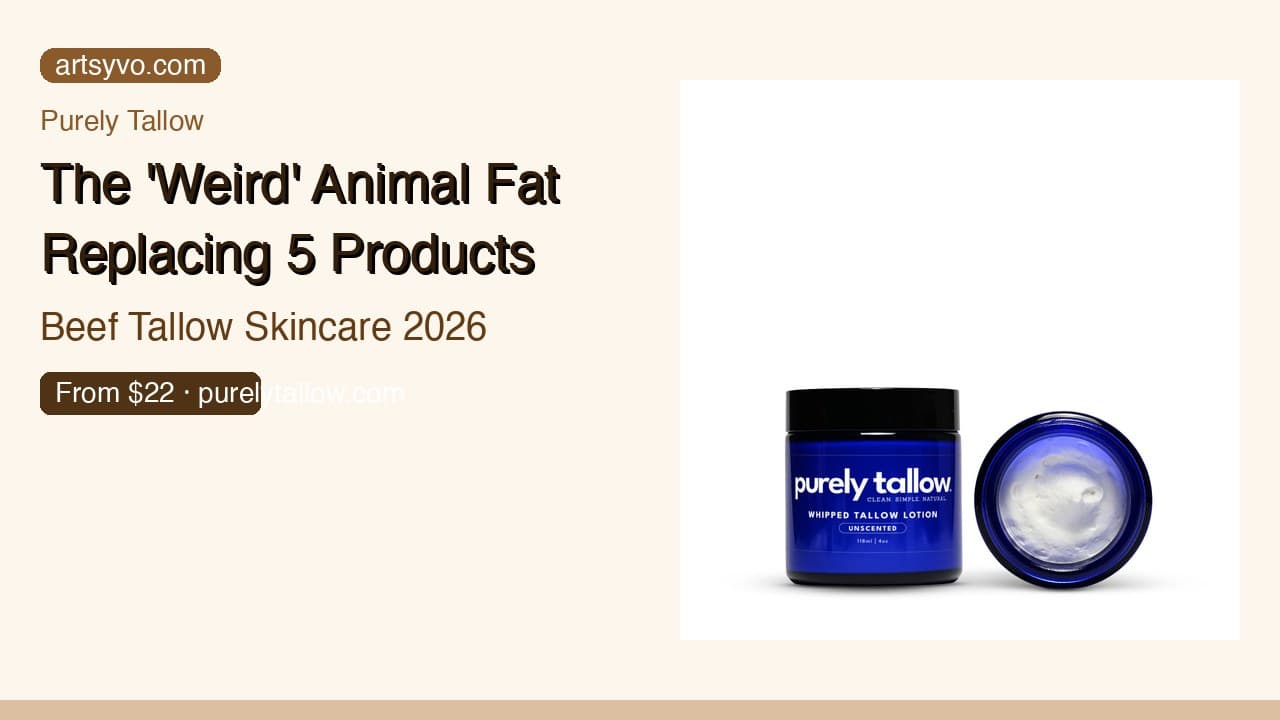
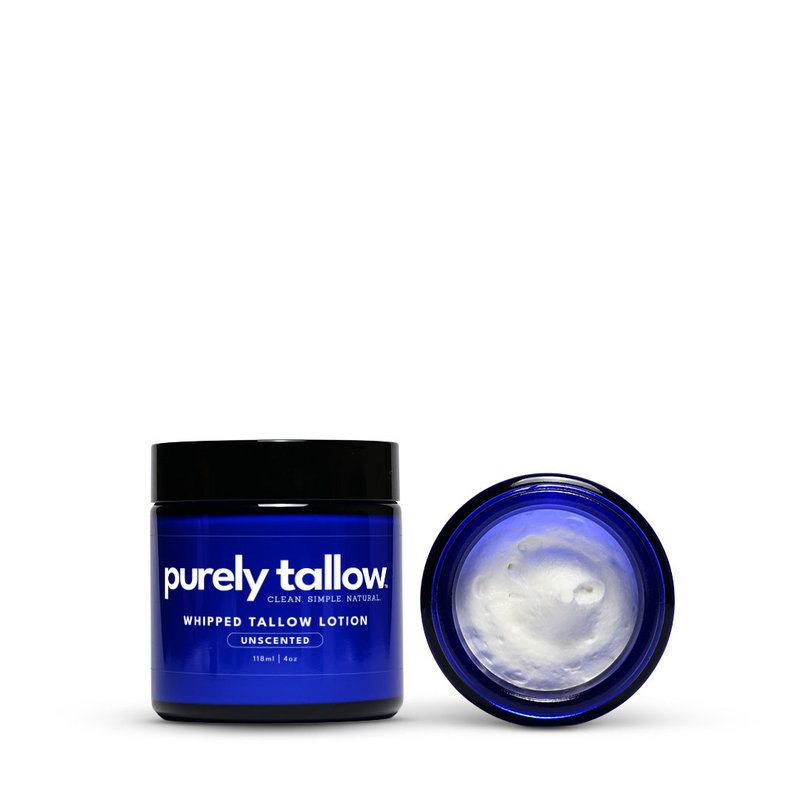
Purely Tallow sources 100% grass-fed beef tallow and uses it as the foundation for every product in their line. No plant-based fillers, no synthetic additives. The ingredient list on their Whipped Tallow Lotion ($22) is short enough to read in five seconds: grass-fed beef tallow. That’s it, in the unscented version.
What Products Does Tallow Actually Replace?
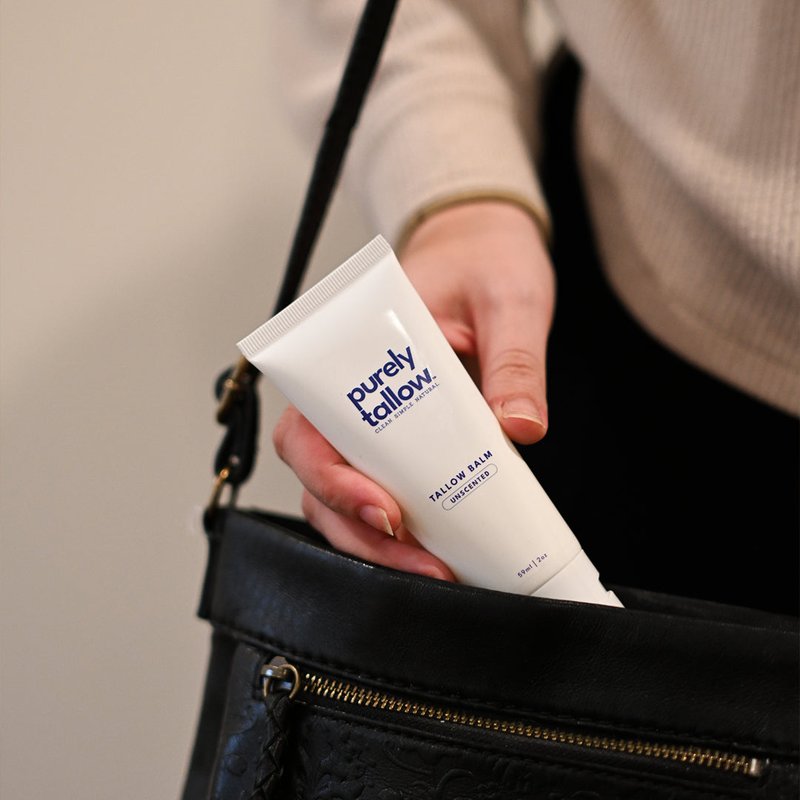
This is the claim that gets the most attention in beef tallow skincare content, and it holds up in practice. A single tallow balm or whipped lotion can realistically replace:
| Product Usually Replaced | Why Tallow Covers It |
|---|---|
| Body lotion | Deep hydration with rapid absorption |
| Face moisturizer | Non-comedogenic for most skin types, barrier repair |
| Eye cream | Rich enough for the thin under-eye area |
| Overnight mask | Layer it thick at night for intensive treatment |
| Hand cream | Absorbs fully, no greasy residue after 5–10 minutes |
The “five products in one” claim isn’t marketing hyperbole — it’s what happens when you use something that actually mimics skin’s own biology rather than layering synthetic compounds on top of it.
Purely Tallow’s Whipped Tallow Lotion ($22, available in 2oz, 4oz, and 8oz) has 366 reviews with a 4.86/5 rating, which is unusually high for a single-SKU product competing against established skincare brands. The common thread in reviews: people who expected a greasy, heavy, animal-smell product are consistently surprised by how lightweight and clean the finished texture feels.
Who Is Tallow Skincare For?
Beef tallow skincare works across a wider range of skin concerns than you might expect, but a few groups get especially consistent results:
Dry and extremely dry skin — the saturated fat content creates genuine occlusion that keeps moisture in, unlike most water-based lotions.
Eczema and sensitive skin — the minimal ingredient list removes almost every possible irritant. When your moisturizer has one ingredient, you know exactly what’s touching your skin.
Carnivore and ancestral diet followers — there’s a direct lifestyle alignment: people already eating nose-to-tail or prioritizing animal foods tend to be drawn to applying the same philosophy externally.
Skeptics of the synthetic beauty industry — if you’re the type to read ingredient lists and Google every INCI name, tallow offers a rare thing: a list you don’t need to research.
Kids and babies — Purely Tallow makes a dedicated Baby Balm ($42) formulated specifically for infant skin. The simplicity of the ingredient list matters more for baby skin than almost any other demographic.
The Smell Question
The number one concern first-time buyers bring up is smell. Does grass-fed beef tallow skincare smell like meat?
The short answer: no, not in any well-made product. Properly rendered tallow has a very faint, neutral smell — sometimes compared to soft butter or mild lanolin, nothing sharp or meaty. When scented with essential oils (lavender, peppermint, Bulgarian rose), the essential oil is all you smell.
Purely Tallow’s unscented versions pass the smell test: neutral, clean, and inoffensive. If you’re scent-sensitive, unscented is actually the ideal starting point.
How to Start: The Simplest Tallow Skincare Routine
If you want to try beef tallow skincare without overhauling your entire routine at once, start with one product on one area:
- After your evening shower, while skin is still slightly damp, warm a pea-sized amount of the Whipped Tallow Lotion between your palms
- Press it into your face and neck — don’t rub aggressively
- Wait 5 minutes — feel the texture change from slightly waxy to absorbed and soft
That’s the test. Most people who try it for two weeks end up reaching for it morning and night. For more detail on layering and which Purely Tallow products pair well together, see how to use tallow balm in your full routine.
Frequently Asked Questions
Is beef tallow skincare safe for acne-prone skin?
Tallow is non-comedogenic for most people, and some acne-prone individuals report improved skin on tallow. However, everyone’s skin is different — start with a small patch test on your jawline.
Does grass-fed tallow matter, or is it marketing?
It matters. Grass-fed tallow has a measurably different fatty acid profile and higher fat-soluble vitamin content compared to conventional grain-fed. The difference is documented, not brand storytelling.
Is Purely Tallow ethical / sustainable?
Purely Tallow uses beef tallow, which is a byproduct of the meat industry — using it for skincare is a zero-waste approach to an ingredient that would otherwise be discarded. The brand is small-batch and family-owned.
Can I use tallow on my face every day?
Yes — many users in the Purely Tallow reviews report using the Whipped Tallow Lotion as their only daily face moisturizer with no issues.
How does tallow compare to coconut oil?
Coconut oil is high in lauric acid and sits on the skin more than it absorbs. It’s also more likely to clog pores for some people. Tallow’s fatty acid profile is closer to skin’s own sebum, which is why it tends to absorb better and feel more integrated with your skin.
Where do I buy Purely Tallow?
Directly from purelytallow.com — the Whipped Tallow Lotion starts at $22 for 2oz and goes up to 8oz. Free shipping thresholds apply; check the site for current offers.
The Bottom Line on Beef Tallow Skincare
Beef tallow skincare is not a trend that will disappear when the next serum goes viral. It’s grounded in biology — specifically, the fact that grass-fed tallow’s fatty acid profile is closer to human sebum than almost anything else you can put on your face. The ancestral narrative is real, but so is the science.
Purely Tallow makes tallow skincare accessible without requiring you to render your own fat or source ingredients from a farm. Their Whipped Tallow Lotion ($22) is the starting point most people reach for — 366 reviews, 4.86 stars, and an ingredient list short enough to tattoo on your wrist. From there, the Trinity Balm ($28, 4.98/5 from 44 reviews) adds beeswax and emu oil for more intensive barrier work.
If you’ve been skeptical about the animal fat skincare movement, the test is simple: try one jar for two weeks. The routine simplification alone tends to make converts.
Recommended for you
 Best Ceramide Moisturizer Under $30: K-Beauty Picks That Outperform Luxury Brands
 Haruharu Wonder Review: The K-Beauty Brand That Strips Skincare Back to Basics
 Haruharu Wonder Ceramide Cream Review: K-Beauty’s Best $24 Pick?
 Best Men’s Hair Clay 2026: Which Formulas Actually Hold Without Crunch?
 Who Is Elijah Matt Clay: Is This Barber-Origin Formula Worth 28 Euros?
 Who Is Elijah Review: The Best Matt Clay and Cologne for Men 2026